Automatic translation of the archived Russian text. Recordings and text within images remain in their original language. Read the Russian original
About this material
Designing progression to avoid repetitive levels: divide the experience into parts, vary the conditions and build a sense of development. The approach is considered for both single-player and multiplayer games, where spawn points, objectives and routes shape the rhythm of play.
When asked for a secret that lets you make a good level in one go, people usually say there is no such thing: it is all talk of a silver bullet, a magical way to solve a difficult problem easily. But I do have a trick up my sleeve that I can only describe as a silver bullet. I call it “building progression into a level.” First, a short digression. Racing films have plenty of conversation scenes. Every James Bond film takes place in several parts of the world. In Pacific Rim, giant robots fight for only part of the running time. If a film has a cool central feature, why does it not occupy the entire film? Because doing the same thing for a long time is called monotony. However delicious a dish is, you cannot live on it alone. Even during sex, pleasant as it is, people change positions.
All of this applies to level design too. If you fill a level evenly with gameplay elements, no matter how skilled you are, it will be monotonous, and playing through it will feel like routine rather than entertainment. So divide the level into parts and decide what distinguishes each part from the others. Then arrange them into a progression so that, rather than creating chaos, they work toward a particular goal: building tension as the player advances, for example, or revealing the level’s theme. Variety does not necessarily require varied content. After all, there are technical limits on asset counts, and producing them costs money. There are ways to build progression using existing content. They will probably seem obvious, but check whether you use every one of them in your environments. Difficulty The main tool for building progression, since it affects gameplay first and foremost. Few people fail to use it, but they do not always exploit its full range. 1. No challenges. This is an option too: pressure is lifted from the player, allowing them to explore an area calmly, for example to absorb important story information. 2. Filler challenges. They merely imitate difficulty so the player can easily defeat everyone and feel powerful. 3. Help with a challenge: allies, temporary super-abilities. 4. Increasing the number of challenges or enemies. 5. Super-challenges that make even non-smokers want to step outside for a cigarette. The key is balancing them to be beatable without letting the player relax.
Colour palette The cheapest and simplest solution if your game has dynamic lighting. Start the level in daylight and end in the evening, or begin with warm colours and end with cool ones. Ideally the palette not only conveys progression but also complements gameplay. For instance, safe areas can have white light and dangerous places red. Or places containing dangerous green lizards can have more green in their decoration. Decide on colour coding during pre-production so one level does not violate the rules established by the previous one.
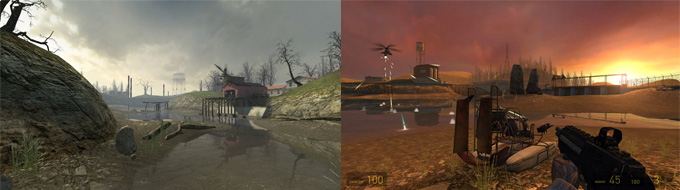
In Half-Life 2, the airboat ride starts on an overcast day and ends at sunset. With enough determination, you can extend this to the entire atmosphere, adding progression in music and effects. Determination is needed because these are other specialists’ domains, not the level designer’s. If they have not already created that progression, the designer needs to persuade them to do a little more work.
Indoor–outdoor It was a revelation to me that Doom’s outdoor areas were actually rooms with a different ceiling-rendering rule. Technically the entire map was indoors, but it did not feel that way. On the contrary, emerging into the open sky after dark corridors was always a pleasure. Moving from an enclosed room to an open area gives the player more space to move, which feels like a change in gameplay. Nobody will leap out from behind a corner. You cannot hide in the next room and shoot enemies one by one through a doorway.
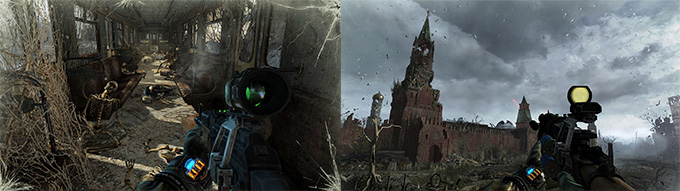
In Metro: Last Light, trips to the surface took place both in open spaces and enclosed rooms.
Emphasizing particular gameplay The player has many abilities to combine while traversing an area. You can emphasize one by temporarily removing the others. Can the player jump? Give them an obstacle course to jump through. Can they shoot? Let them stand at a machine gun and mow down charging hordes. Can they swim? Part of the level has flooded, so they have to swim. Can they crouch? No, let us not go there.
Guild Wars 2 has many places where no skill matters except jumping.
Redistributing decorative objects If a level is made from a setting-specific asset kit rather than from scratch, you can distribute those assets unevenly too. Let players discover more new visual objects as they advance through the area. It is a micro-reward for progress: the more you play, the more content you receive. This especially applies to objects that tell an area’s story. Suppose you are making a level about a hero sneaking onto a spaceship overrun by xenomorphs. You have objects belonging to the ship’s setting and objects showing traces of the xenomorphs. At the beginning, give the player only ship objects, telling the ship’s story. Further on, introduce a few xenomorph objects to tell the story of their invasion. At the end, use them to create a bloodbath that tells the player everything has gone terribly wrong.
Background Changes can happen outside the playable area as well, in places the player can see but cannot reach. If you have no such places, consider whether that is a serious problem. Even indoors you can replace a wall with a window, or a railing that cannot be jumped, looking into another room. It might contain neatly arranged office furniture, a mess, or an industrial machine. Outdoors, it might be a building, forest, hills, or mountains.
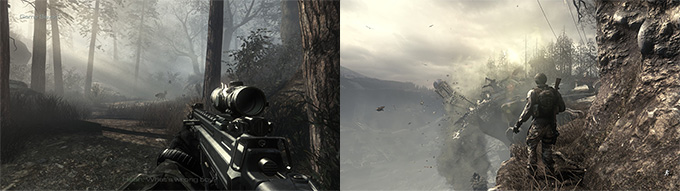
Call of Duty: Ghosts. The level begins on a path, with no background. Later we are technically still on a path, but the background changes the impression.
New kinds of challenges or enemies Challenges are also content that can reward the player for progress through a level. If you plan to use three enemy types, for instance, fill the first third of the level only with the first type, the second third with the first and second, and the final third with the second and third.
Changes in scale A level might begin at the walls of an enormous temple, then move into narrow corridors. Or it might begin in a narrow gorge and end with an epic boss battle atop a huge tower overlooking the entire level. Scale progression includes object size, the density of their placement, and space available to the player. Remember, though, that size is relative. A thirty-metre tree is ordinary, but a statue of the same size feels enormous. A large boss arena may be perceived negatively: a flat, empty space that takes ages to run across. Make it small but place several similar arenas in the nearby background, and you can still convey a sense of size.
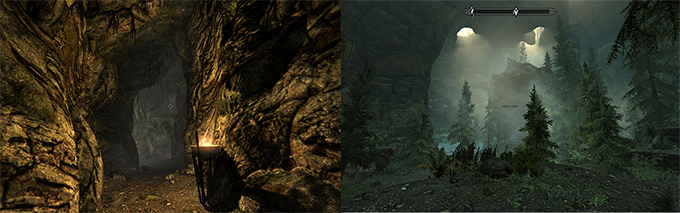
In a dungeon in The Elder Scrolls: Skyrim, you start in a narrow passage and emerge into a spacious cavern. When placing large objects, consider the usual camera angles. Players may never see your towering marvel if they spend most of their time looking at their feet for loot.
Direction of movement Not the most important item, since it is less obvious to the player, but it still deserves attention because it affects the experience. If players can walk forward, turn, descend, and climb, emphasize particular movements in different parts of the level. For example, the player first climbs a hill and sees a building, then walks almost straight toward it. Inside, they make ninety-degree turns, find the entrance to a secret laboratory, and descend for a long time.
Progression in PvP maps Progression applies to PvP maps too. In the heat of battle, players care little about cosmetic environmental changes, so the changes must affect gameplay, which can be broken down into where the player runs from, where they run to, and how they get there. From where. Respawn points are not fixed. Players may respawn near teammates or at captured control points. This already changes the player’s experience after respawning. To where. Points of interest move around the map. These might be control points where capturing one unlocks access to the next, or a slow-moving object to defend or attack. Unlike the previous item, this changes the player’s experience before their next death. How. Dynamic level changes affecting gameplay. Routes appear or disappear, as when a level floods in Battlefield. Existing routes become more or less dangerous, as when defensive towers are destroyed in MOBA games.
The arrival of Payload mode gave Team Fortress 2 a new lease of life.
Bonus: these reflections were inspired by the Nürburgring racetrack. Like all tracks used for Formula 1 Grands Prix, it is excellent in gameplay terms. Its monotonous scenery, however, is depressing: nothing but green trees. Of course, if you reproduce it in a licensed game, you have to preserve that dullness. But you should not make your own level that way.