An analysis of the story of The Vanishing of Ethan Carter [SPOILERS!]
Articles
Automatic translation of the archived Russian text. Recordings and text within images remain in their original language. Read the Russian original
About this material
A detailed personal interpretation of The Vanishing of Ethan Carter, exploring how environmental investigation reveals several nested stories. Intended for people who have finished the game, it discusses the ending and contains major spoilers.
I recently finished The Vanishing of Ethan Carter and now I want to talk about this game. Despite its short playtime and simple mechanics, it manages to draw you in with its story. The Vanishing of Ethan Carter explains its rules from the very beginning: “The game is a narrative experience that does not hold your hand.” That is the end of the tutorial. Nobody is going to tell the player the story. Everything depends on how much the player wants to discover it, piecing it together themselves. This is a fresh narrative experience in games, so I would like to examine it in more detail as an example for narrative designers. Everything below is intended for people who have finished the game. If you have not played it, come back to this post after you do. Do not spoil your chance to have your own experience of the game.
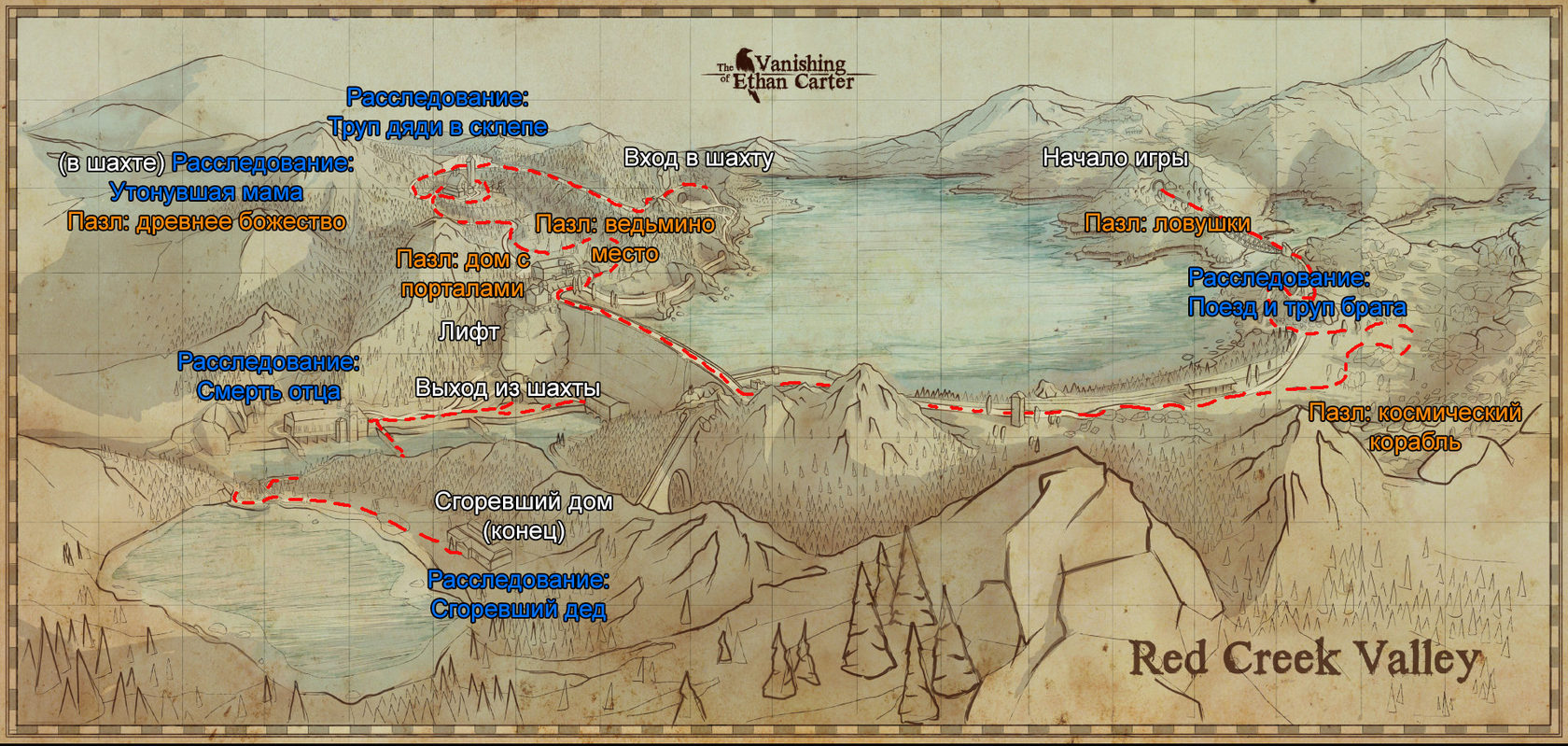
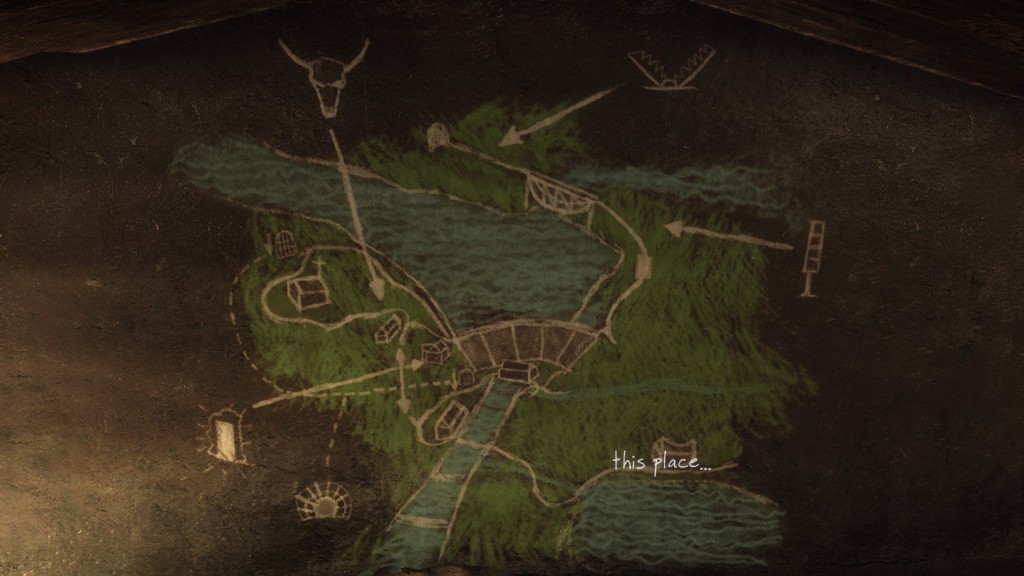
Disclaimer: Everything below is my personal understanding of the game’s story. I may have misinterpreted some discoveries or found meanings that the developers never intended. If you find a mistake, let me know in the comments. Once you have pieced the whole story together, you realize that it is actually several stories hiding behind one another like the layers of an onion. The more you explore one story, the more clearly you notice another underneath it. And it all begins with the player’s story. The player’s story The player has the simplest story and the simplest role. This makes sense, because the player is a chance visitor to this world. They just dropped in to see what this game is that everyone is talking about, with all those beautiful screenshots. Their task is to control detective Paul Prospero, walk around Red Creek Valley, find and solve puzzles, and ultimately find Ethan. The entire game is a single seamless open world. You can move from any point to any other at any time, even from the very end back to the beginning. A map of the area can be found in the bonus materials, if you find those, but I found it in the game’s Steam community. I marked the gameplay elements that the player encounters on it. Clicking the map opens it at full size in a new window.
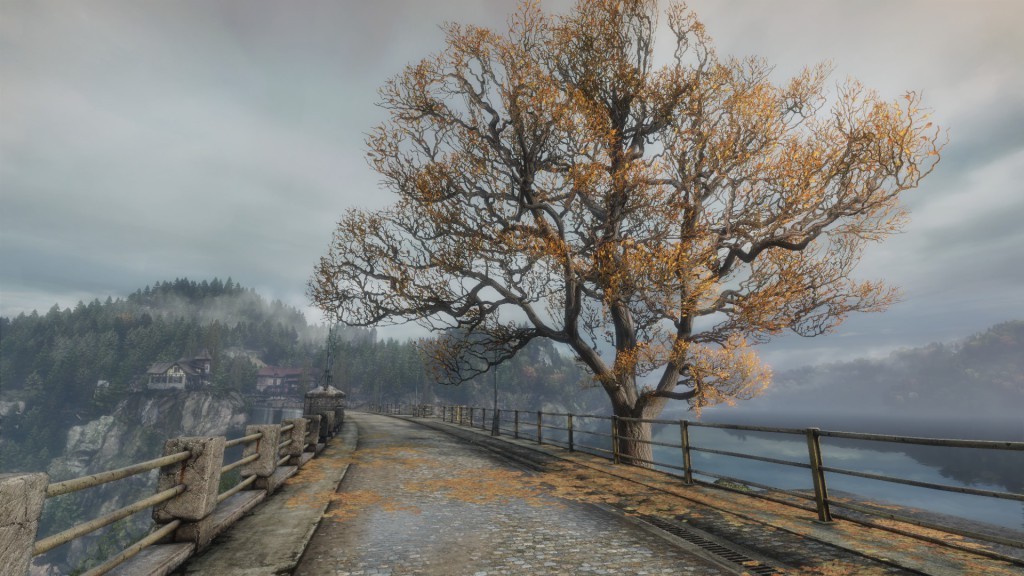
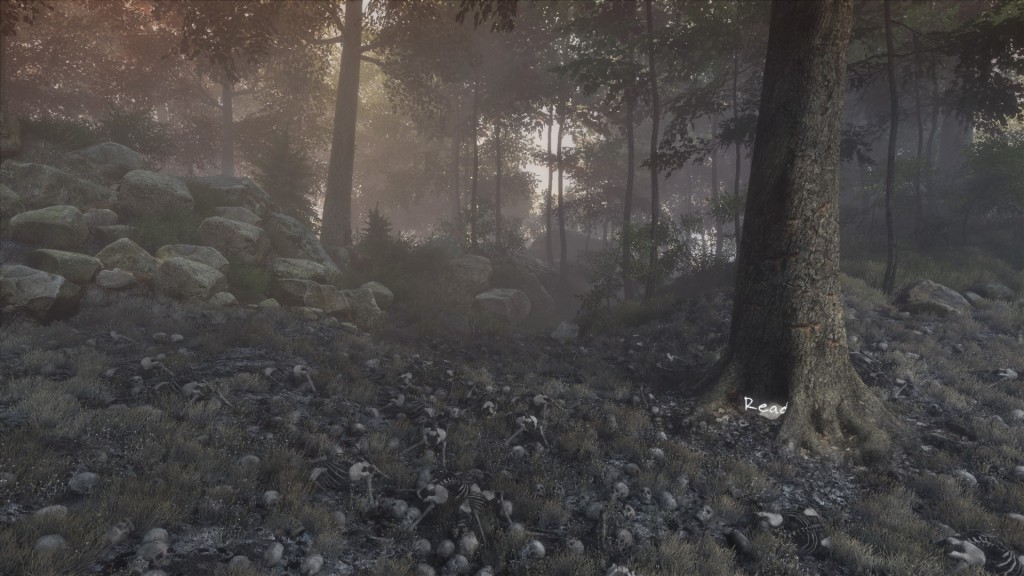
Although the game has no tutorial explaining what to do, the player has no trouble with it. The player simply cannot do anything they are not supposed to do, so all that remains is to do what they should. There are no special interfaces or resource management. There is not even the traditional stamina resource: you can run forever. Although running is much more convenient for getting around this enormous world, it is not the player’s default movement, because a detective sprinting about like a whirlwind would be out of character. Fast movement is therefore the player’s choice, rather than the detective’s. The sequence of views revealed to the player is interesting. At first the player is in a forest, with no vistas at all. But upon reaching the bridge they can see a dam in the distance and, if they look carefully, a railway station. It is a kind of preview of the story, like a gun hanging on a wall. Likewise, approaching the dam reveals houses at its far end and a power station below. All of these places also have roles in the story. A player accustomed to other games will probably regard them as non-interactive background scenery, but when they reach them on foot, they will feel the pleasure of recognition. From those places the player can also see where they have already been: the bridge from the dam, and the portal house from below the dam.
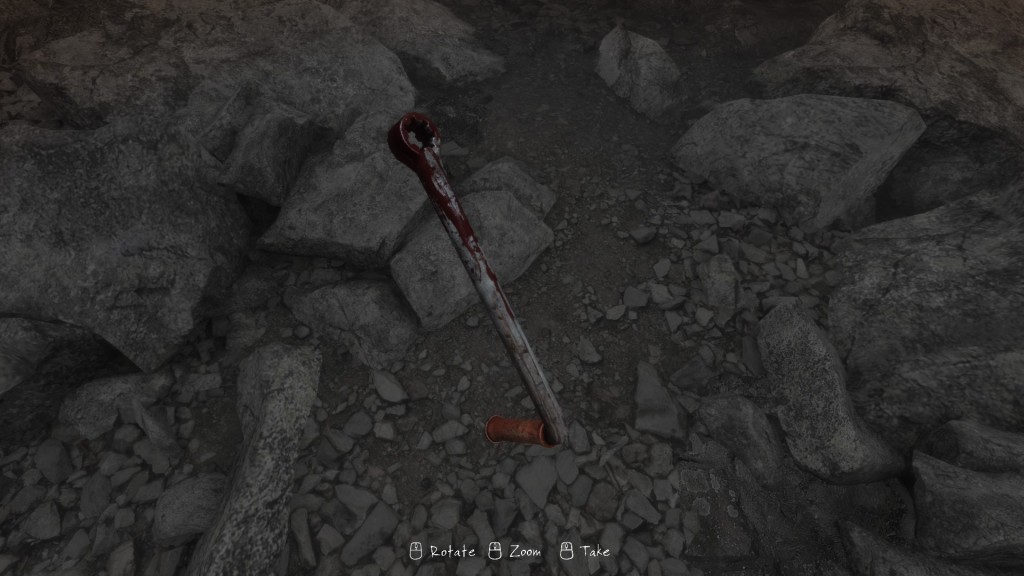
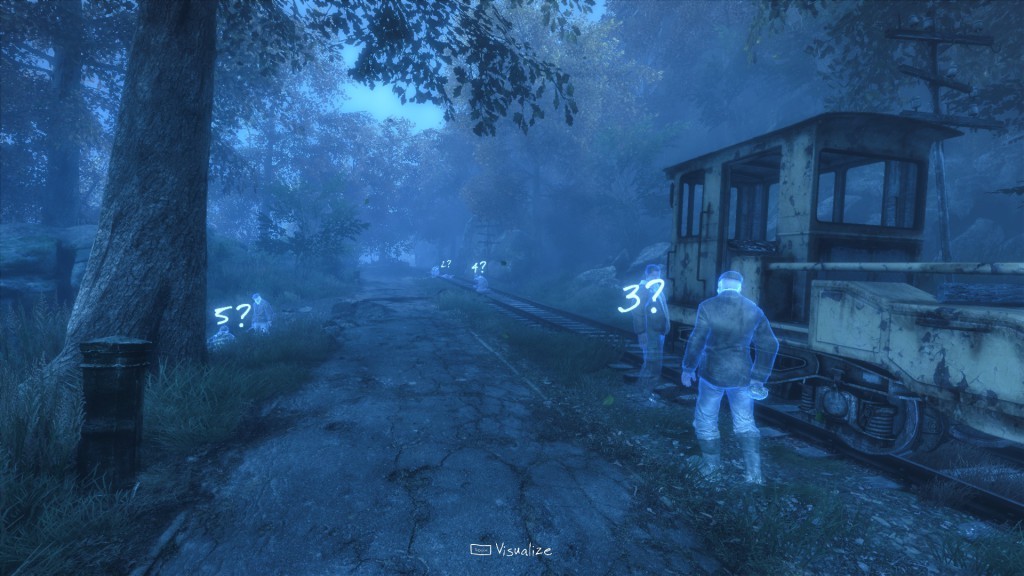
Along the way the player encounters two kinds of puzzles: crime scenes and supernatural stories. The first follows the same template throughout the game: find every object, put them in their proper places, examine the corpse, examine all the key moments of the murder, arrange them in the correct order, watch them play out, and receive the reward—a scene about Ethan. Places where objects should be used are highlighted with words as you approach. Looking at these places gives a hint about which direction to search for the required object and what its location looks like.
Each supernatural story has its own mechanics; the only thing they share is that you read one of Ethan’s fictional stories at the end. Traps: find all five. Spaceship: find a strange device in the forest, work out the code, chase an astronaut (remember, the developer is called The Astronauts), board a flying ship, and read a note. Portal house: match each portal to the correct room; to do so you can first inspect the original and listen to stories about Ethan. Witch’s place: leave the road for the forest, listen to the witch, and walk toward the light. Ancient deity: descend into the depths of the mine, look for the sailors’ corpses, hide from a walking dead man, enter the code into an ancient portal, and read the story. After you read a story, one or two more notes appear nearby, but more on that later.
After solving all the puzzles and reaching the burned-down house, the player finds Ethan and ends their own story. All that remains is to watch the final cutscene and the credits.
The supernatural story of Ethan’s disappearance
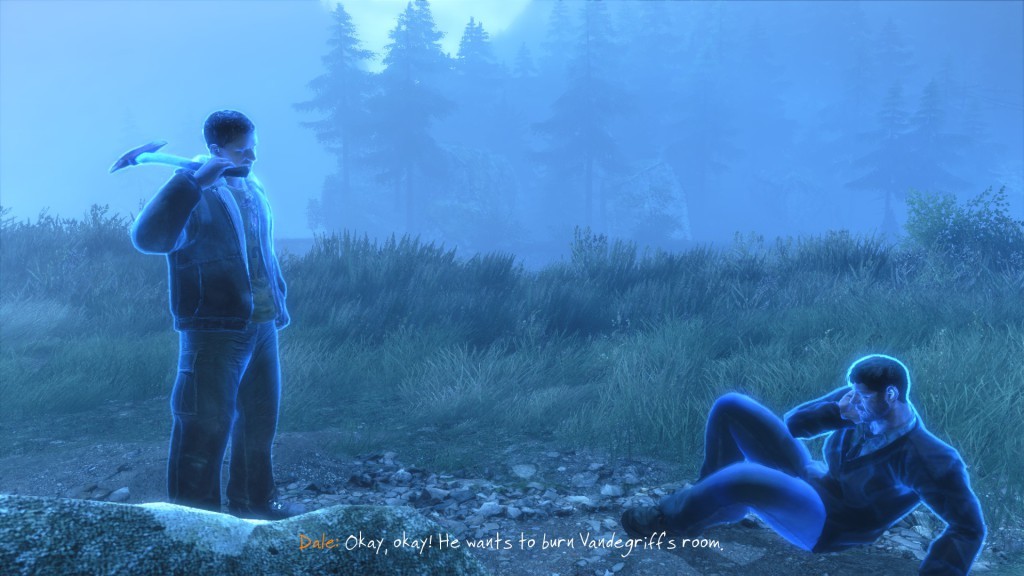
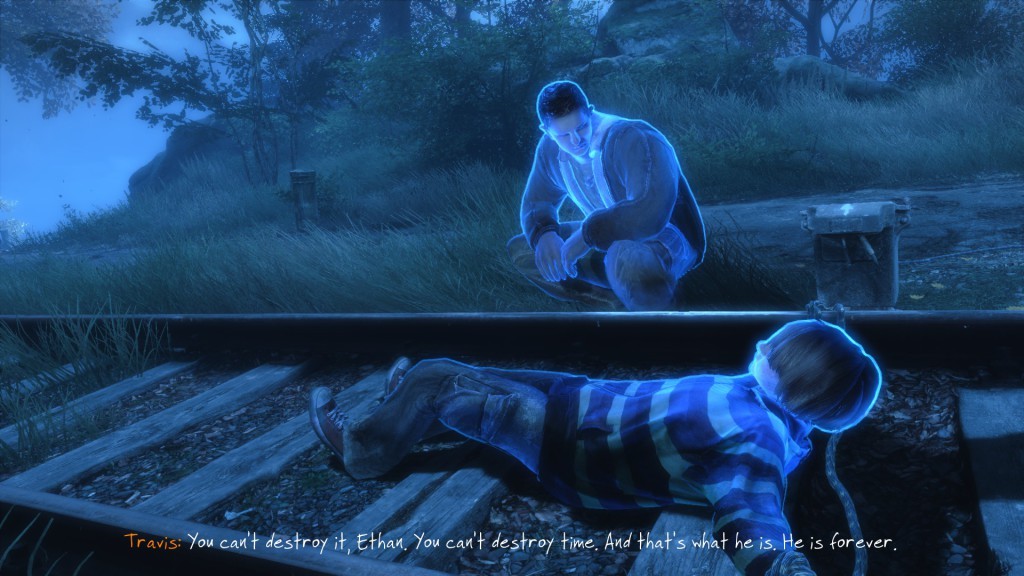
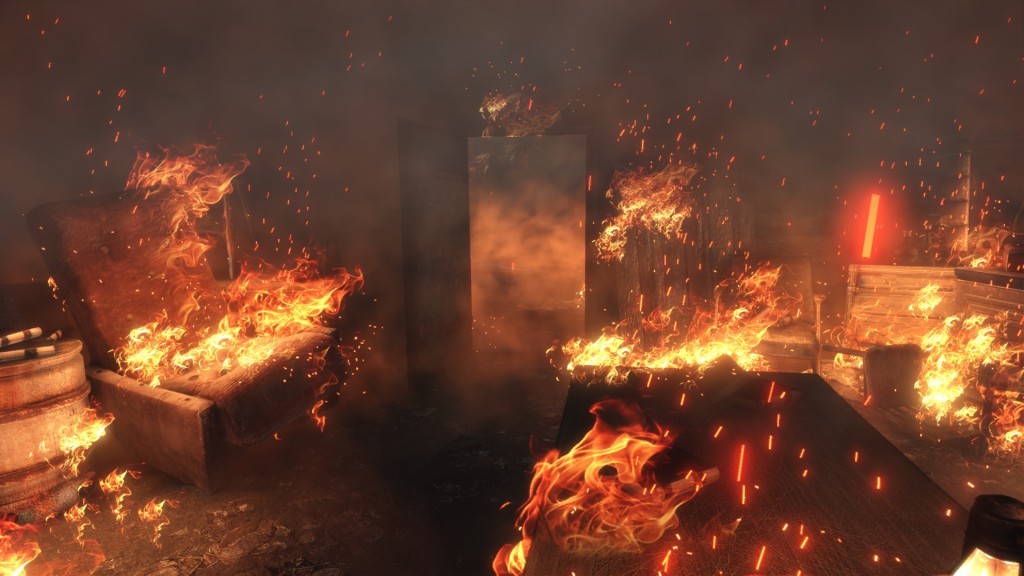
This is the first story the player discovers, because it lies on the surface and is where the narrative begins. A boy is in trouble, and only we, a detective with supernatural abilities, can help him. The very first story, involving a train, tells us that the boy’s family is possessed by dark forces, a being called the Sleeper. Later we learn that Ethan found a secret room in the abandoned home of the Vandegriffs, awakening the Sleeper. Now the Sleeper wants to wake fully and bends the boy’s family to its will. His grandfather and father resist, but his mother, older brother, and uncle side with evil without hesitation. For the Sleeper to awaken, the chosen victim must suffer. First they try to wall Ethan up in a crypt, then to run him over with a train, and finally his grandfather, succumbing to the Sleeper’s will, locks him in a room. Ethan’s goal is to burn down the secret room to destroy the Sleeper. Even trapped inside it, he pours out a can of petrol and burns the room, and with it the entire house. Paul Prospero is too late. When he arrives, the house is already in ruins.
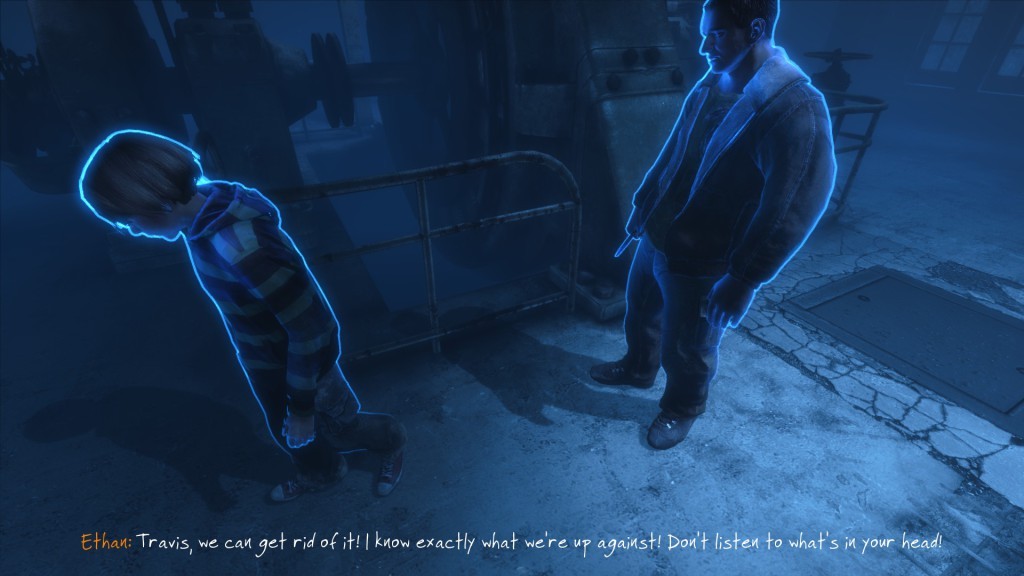
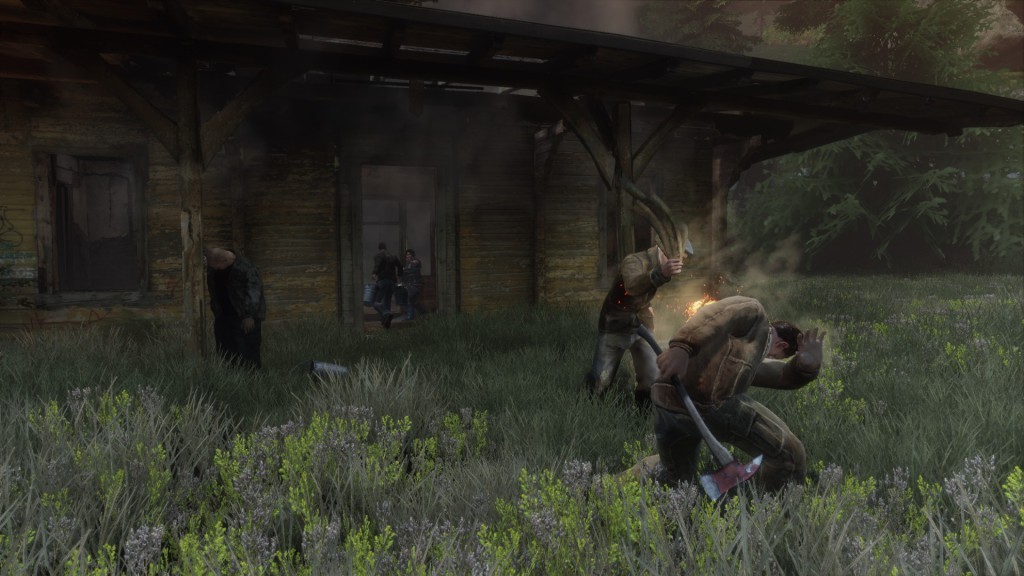
The story is not presented to the player in the order in which it happened. The first episode the player finds is actually the penultimate one. Films often do this, showing something near the end right at the beginning, to create intrigue. We see the grandfather kill the older brother, Travis, yet the older brother appears in every subsequent episode except the last. The situation with the scissors the father uses to kill himself is interesting. We see Travis drop his axe when he realizes his father has done it himself. But we found the scissors near the lift. We might assume that Travis took them and later used them to threaten Ethan in the dam’s control room. The scene is brief, and it is hard to make out the short, sharp object in the older brother’s hands. But it would make sense. If he had a knife, he would not have needed the scissors to cut rope from the spool in the lift that carried him and Ethan to the railway, where he would tie Ethan up with that rope. It is worth noting that the scissors were moved not just for narrative reasons, but also to show the player the location of the lift, which provides a quick way back up.
The family’s story
Of course, we could stop at the Sleeper story: a possessed family killed one another and forced a boy to burn himself alive. But even the least attentive player will see the final cutscene, showing the whole family together and an accidental fire, and realize that it is not so simple. Read all the notes carefully, and another story emerges: the family’s real story. Near the entrance to the large house beyond the dam, you can find this photograph of Ethan’s family: his mother Missy, father Dale, older brother Travis, uncle Chad, and grandfather Ed. It is never stated explicitly which side of the family the grandfather and uncle are from. There are no scenes of the grandfather speaking to anyone in the family except Travis. As we walk around this house, we hear relatives discussing Ethan with one another. We can assume that this house was the Carter family home. Each puzzle—not the investigations—is dedicated to a member of the family. Ethan’s story, found at the end, is about that person. After the story we hear that relative say something, then find new notes or objects connected with them. At the very beginning, for example, after solving the trap puzzle, the player finds Ethan’s story about an old man who drank tree sap and hid it from the other villagers. A fire broke out in the forest and then the village; everyone burned, while he kept drinking sap. After this story we find bottles and a newspaper clipping about a fire beside the note. The clipping says that Gayle, the grandfather’s wife, died in a fire caused by his unextinguished cigarette. The story, bottles, and clipping easily suggest that the grandfather was a heavy drinker. Perhaps he kept his booze in the forest so his family would not find it and take it away. One night, completely drunk, he started a fire that spread to the family house and killed his wife.
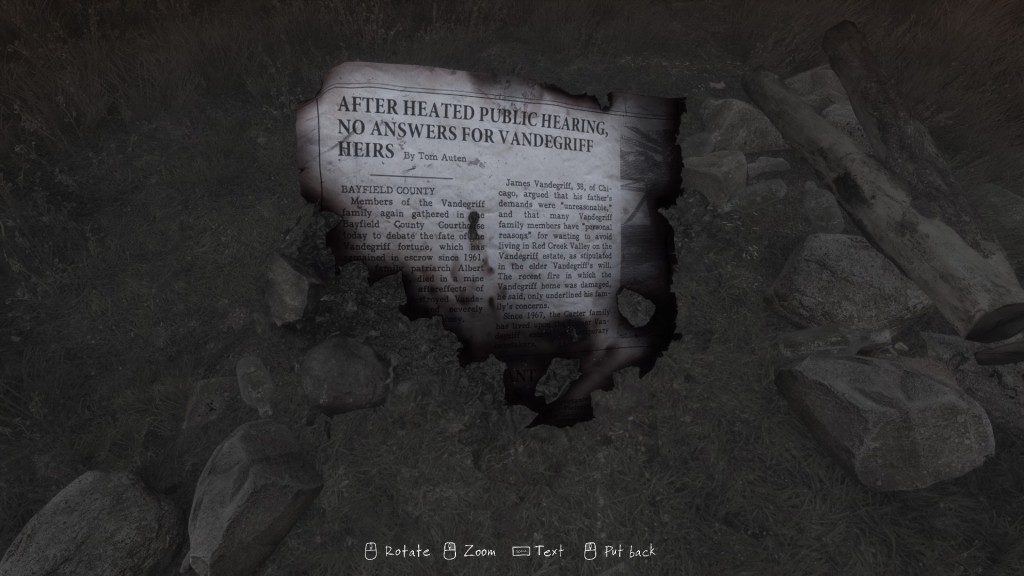
The back of the newspaper clipping mentions the Vandegriff heirs’ legal battle over their father’s estate. It describes the will’s absurd conditions and the heirs’ desire to avoid the lakeside house, particularly after a recent fire damaged it. But this is not the fire in which Ethan burned. The clipping mentions a family of six, and grandmother Gayle was alive then, which means Ethan had not yet been born. So for Ethan, Gayle and the fire are echoes of a past he never saw but often heard about. The next puzzle is about the older brother. After playing astronaut, we find Ethan’s story about fangs—or, more precisely, about an animal that encountered a light in the forest like the one we saw from the spaceship. A stupid but dangerous animal: that is how Ethan sees his older brother, who cannot appreciate the delights of fantastic stories. The writing Travis scrawled across the magazine speaks volumes about that.
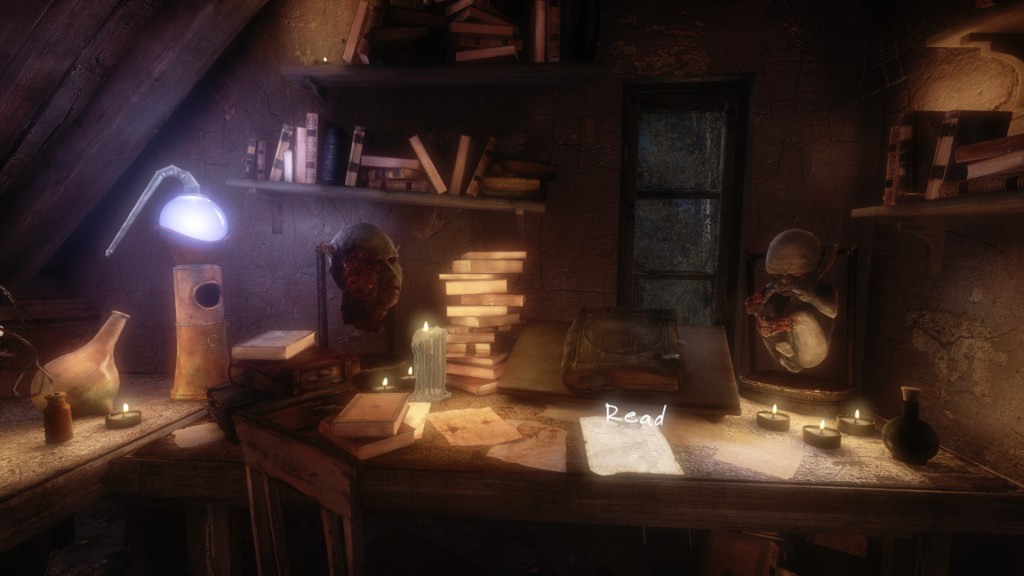
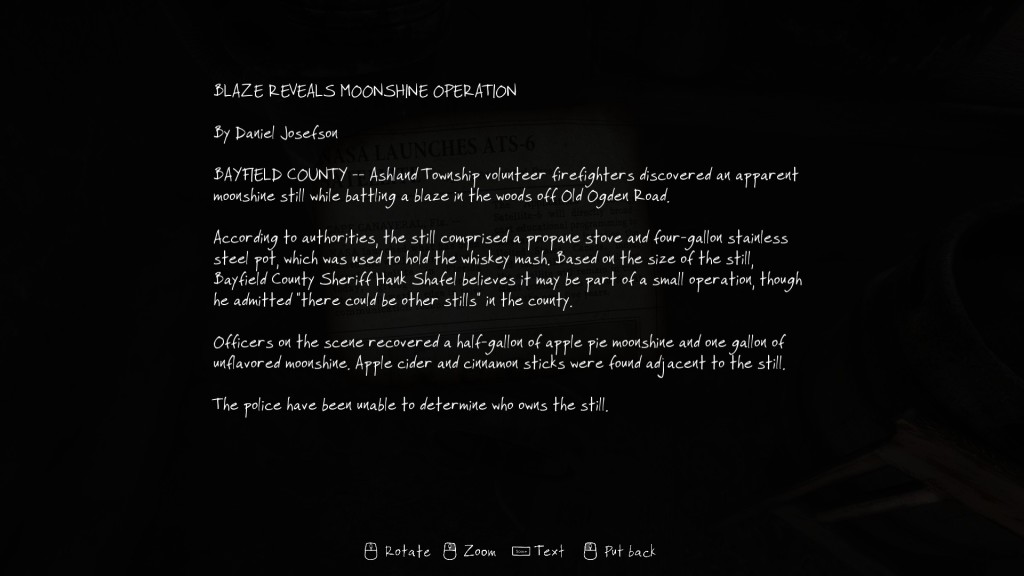
In the portal house we find an alchemist’s secret room and a story about how he made potions that let him see the future. Common people came asking for these drinks, but he refused. Offended, they burned down the alchemist’s house. But he knew this would happen because he had seen the future, so he hid in a secret room and never came out again. The voice after this story makes it clear that it concerns the uncle. The room’s subsequent appearance and a note reveal that Chad was making moonshine illegally. The still stood in the forest, where volunteer firefighters found it while fighting a forest fire. Apparently this was where the grandfather went to drink. The police could not establish who owned the still, so the uncle went unpunished. The back of the newspaper clipping carries a story about NASA launching a satellite that will broadcast educational programmes: a striking contrast to the story of a moonshiner.
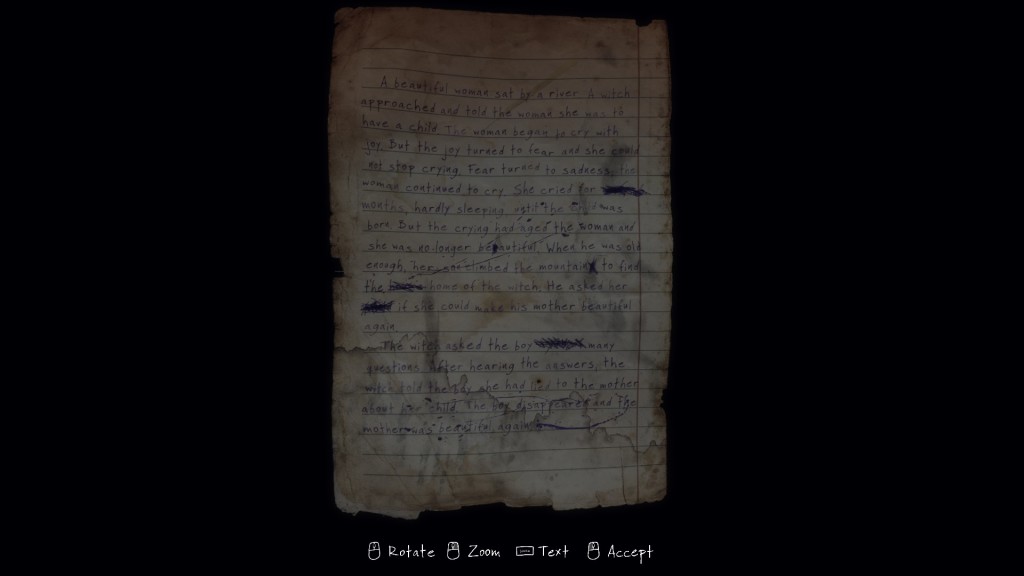
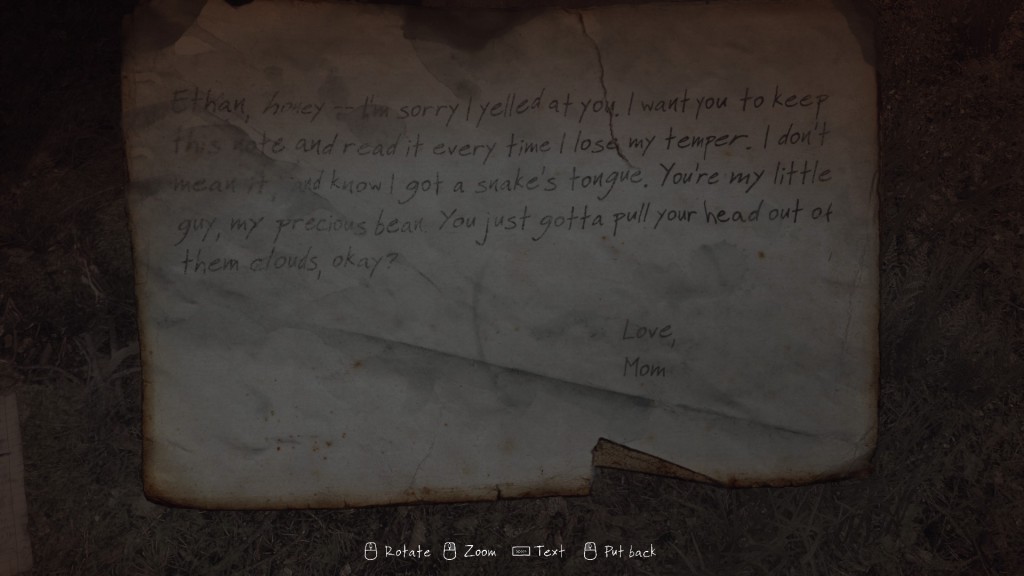
After passing the two houses beyond the dam, the player can take either of two roads or enter the forest. But just a short way into the woods, you fall under the influence of a forest witch, very much like the Blair Witch. The witch says people come to ask her about the future, and she knows the future. First, however, she must answer questions about the past. Do we admire thieves for their courage or their greed? Whose voice do we hear when we close our eyes? And other questions. We never have to answer them. At the end we find a story in which a witch foretells a child for a woman. The woman weeps first with joy, then with fear, then with sorrow. She has a son, but her weeping ages her and she is no longer beautiful. The child finds the witch and asks her to make his mother beautiful. The witch says she lied to the woman about the child. The woman becomes beautiful, and the child disappears. Next we hear the mother lecturing Ethan for being lost in his daydreams again. This is undoubtedly the mother’s story. The note that appears after reading it is from her: she admits she can lose her temper and asks her son to remember that. She again asks him to stop having his head in the clouds. Also notice the back of the story: it is an earlier draft that Ethan corrected, apparently thinking it was not good enough. Most likely this reflects his mother’s upbringing: she made him believe he was not a good enough child, and that without him she would be better, more beautiful. No wonder she gets the witch theme, and hers is the voice he hears when he closes his eyes. Finding a hut among burned trees in the forest, where the still should logically be, suggests that Ethan’s mother was involved in Chad’s moonshining too.
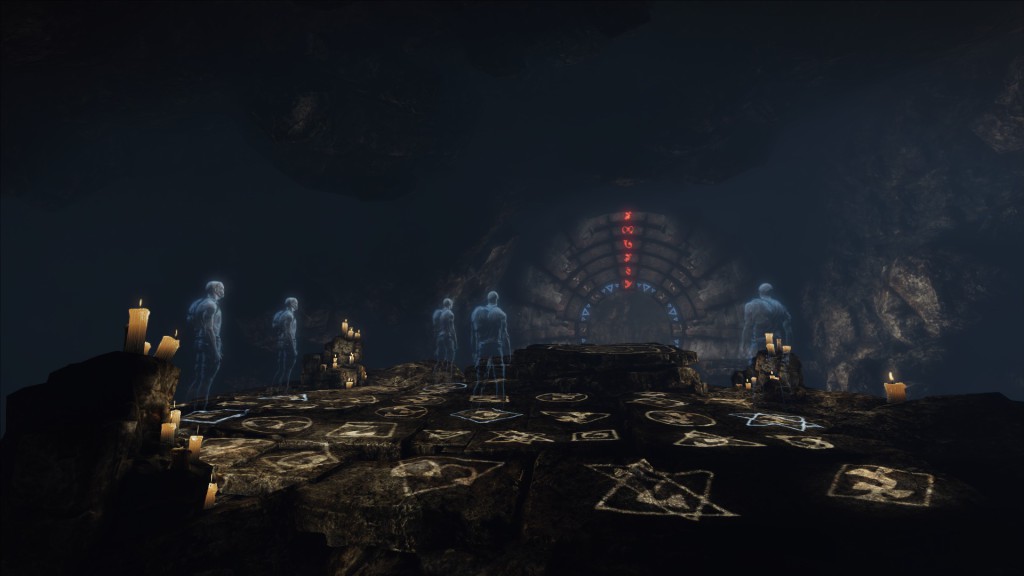
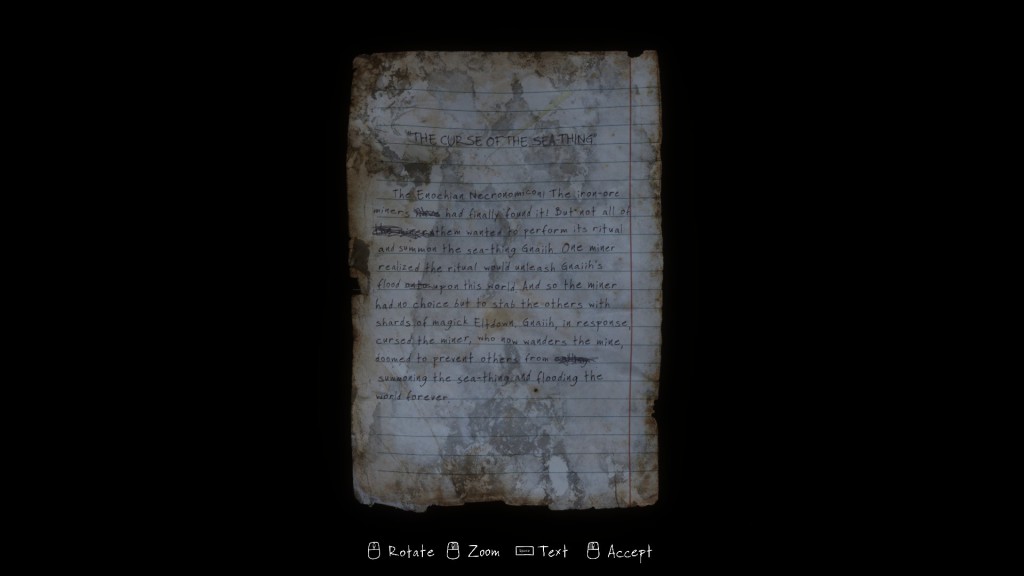
The final story belongs to Dale, Ethan’s father. You can find it deep in the mine: rather than riding the mine cart all the way to the “boiling” water, get out earlier at the illuminated passage and descend a long way until you find a warning about an unfinished ritual. This is perhaps the game’s only action sequence. The player must explore a maze while hiding from a walking corpse. If it spots you, however, it frightens you but does not end the game: you are transported to the entrance of the maze. Maps appear frequently in the maze, so it is hard to get lost. One large chamber stands out on the map. Inside are a corpse, a note, mysterious gates, and a chart of symbols. Each dead man you find stands on a symbol and projects a pattern onto it—a square, triangle, circle, and so on. The player must find five corpses to obtain five symbol–pattern combinations, then enter the symbols on the gates in the order indicated by the patterns. You have to work out the last symbol by trial and error. Entering the symbols summons an ancient sea monster, or rather its enormous tentacles, and the world floods. After enjoying the flooded world’s vistas, the player finds another story. It says that miners discovered the Necronomicon and decided to perform a ritual summoning a sea monster that would flood the world. One miner tried to stop this and killed the others. The monster cursed him for it, and now he must wander the mine forever, preventing the ritual. That is why we never found the final corpse for the symbol chart.
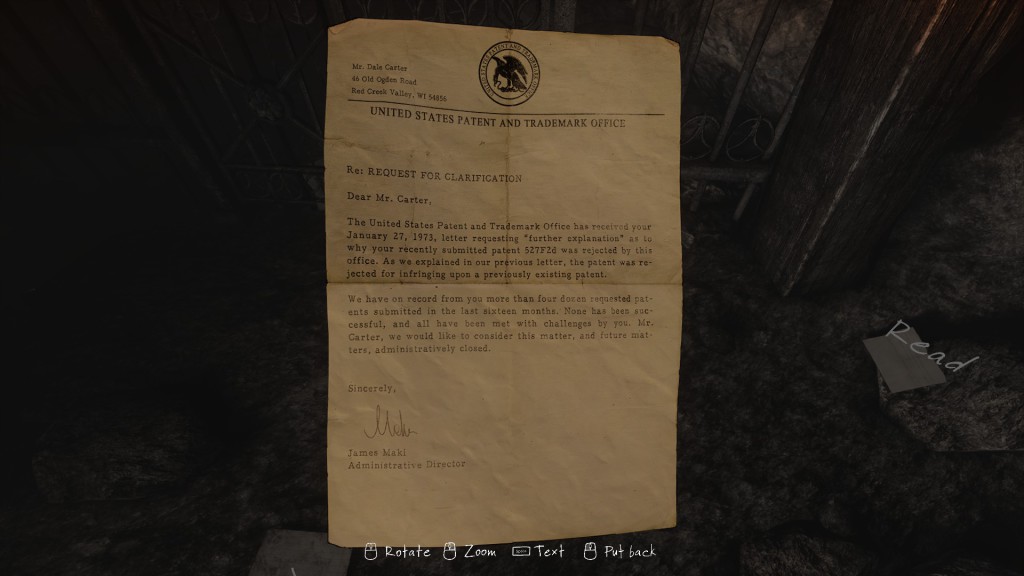
After this story we hear the father’s voice, then receive two more notes. In one, the patent office says that over the past six months Ethan’s father has submitted more than four dozen patent applications, had every one rejected, and appealed every rejection. All further questions are now considered closed. Beside it is a letter from his wife, Ethan’s mother, speaking very harshly about the things Dale keeps in the basement and threatening to burn them unless he throws them away. In short, everyone who could has walked all over Dale. Earlier crime scenes already showed his uncle, and then his wife, laying into him. After the mine we will see that his older son could not care less about him either.
The detective’s story
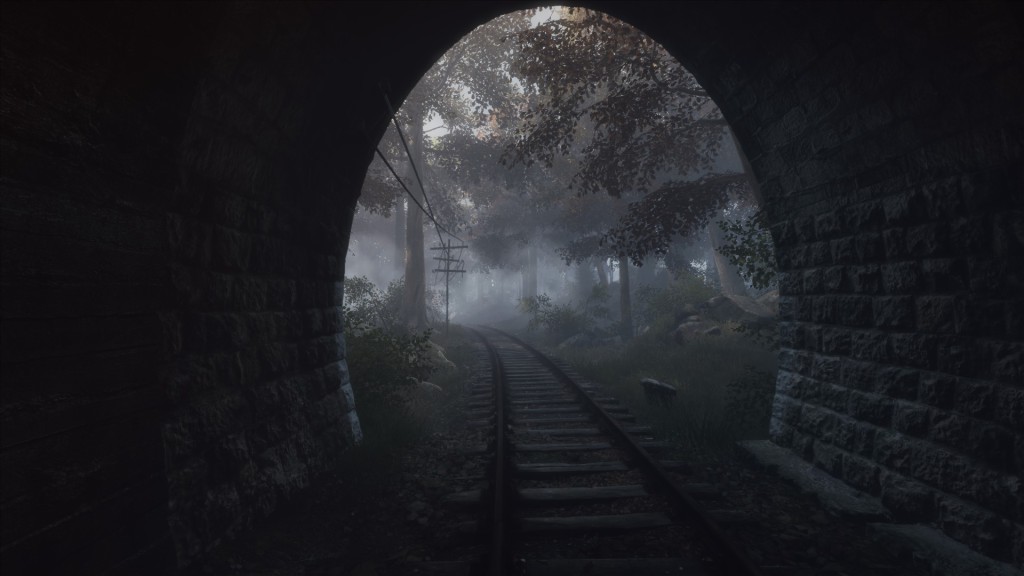
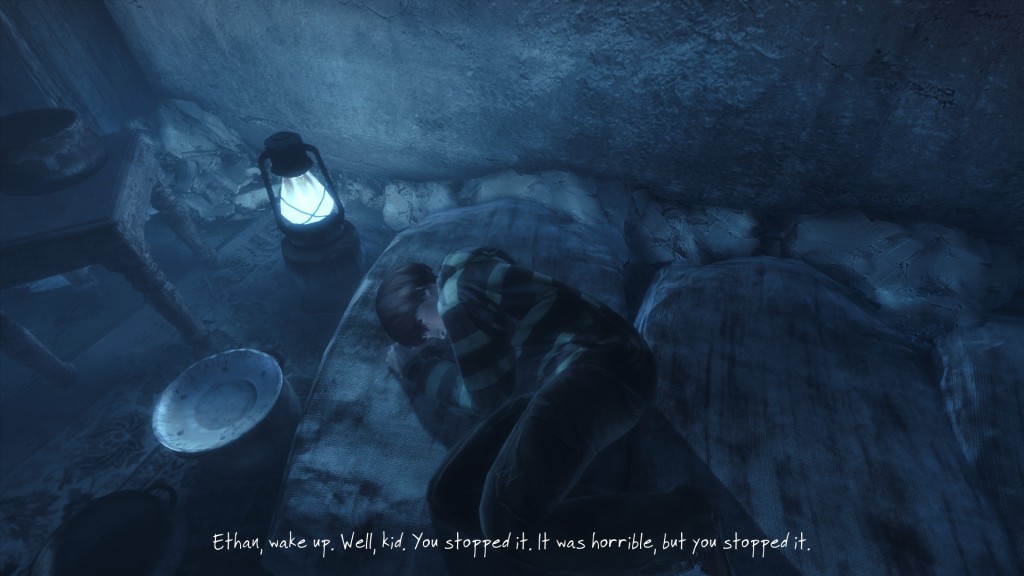
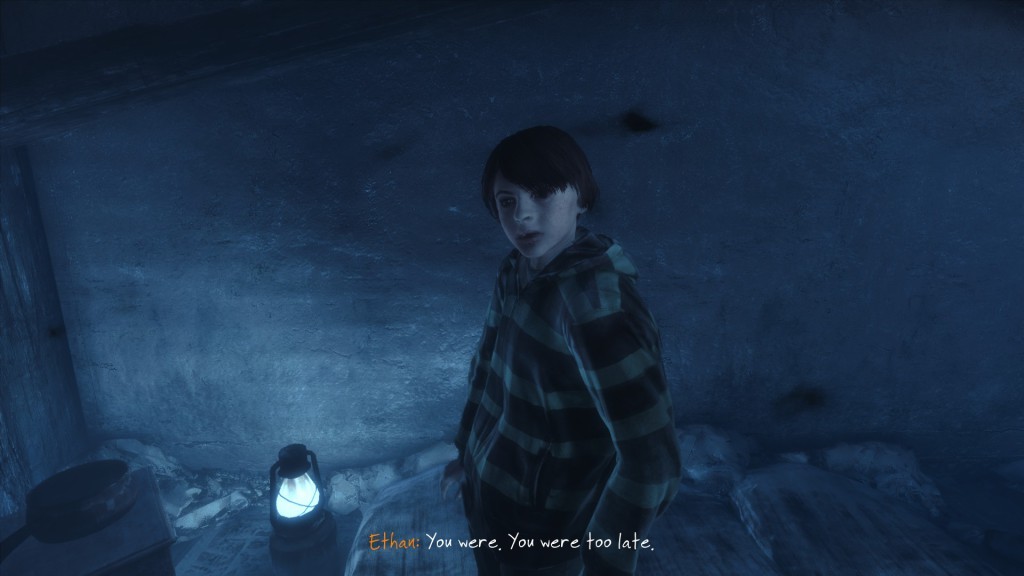
The stories do not end there. Although the player controls the detective, Paul has a story of his own: Ethan’s final story. At the start of the game the detective delivers a film-noir-style introduction, with lines such as “If you’re a kid like Ethan, you write. Plenty do,” “Ethan could draw a map,” and “I was too late.” At the end we learn that Ethan wrote a great deal, drew a map, and that we really did arrive too late. The beginning of Paul Prospero’s story—Prospero is Latin for prosperity—is the end of Ethan Carter’s. But it is not only Prospero who is fictional; the entire world in which the game takes place is too. The location of the still points directly to this. In the newspaper clippings it was in the forest; in Paul’s world it is in a secret room in a house. The world’s strangeness also indirectly suggests that it is invented. For some reason the detective walks along railway tracks in a tunnel. A railway station stands in the middle of a forest. All the houses have long been abandoned—where did the family live? A large church is isolated, with no nearby settlement whose people might fill its pews. A working mine and dam have nobody to maintain them. No road leads to the Vandegriff house. All of this suggests an invented world. A child placed only the objects needed for his stories in it: vivid images from his childhood. Of course, this is only a theory. But I doubt that developers capable of making a game of this quality would have made all these mistakes by accident. At the end of the game the detective finds Ethan asleep and wakes him, saying that it is all over. It was terrible, but it is over. Ethan is surprised to see the detective in his reality.
Ethan’s story
Putting these stories together with the events of the final cutscene gives us Ethan’s story. The boy has a terrible family. No wonder he tried to escape them through his imagination. He hid from them in the abandoned Vandegriff mansion, where he wrote his stories. He drew an imaginary world and filled it with stories. One day he became so absorbed in writing a story that he missed lunch. The whole family went looking for him. Ethan’s mother carelessly turned sharply in response to a rude remark from Travis, starting a fire. The house burst into flames immediately. Ethan had no option but to shut himself away from the fire in his secret room. But carbon monoxide seeped through the cracks. The boy fell asleep and saw his final story. Paul Prospero, Red Creek Valley, the player—all are the dream of a boy who would like to wake up, but never will.
Story details
In the attic of the Carter house you can find an armchair with a book on it. Beside it is a table with more adventure books: Treasure Island, From the Earth to the Moon, The Island of Doctor Moreau, and King Arthur and His Knights of the Round Table. We can assume Ethan spent time reading here.
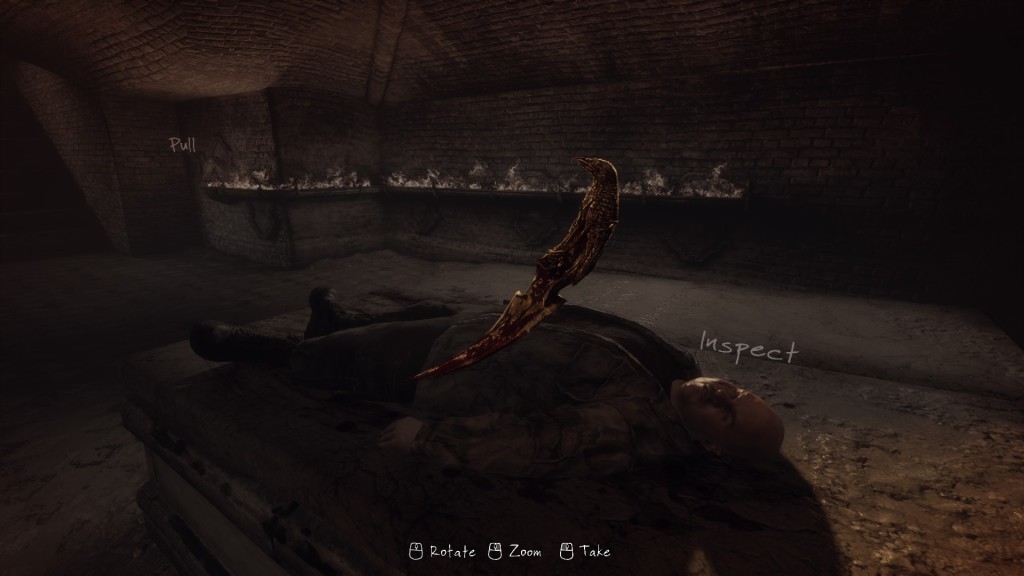
The game’s logo features a raven—see the post’s header. Ravens also appear in the decoration of the Vandegriff crypt. The ritual knife that killed the uncle is shaped like a raven. Ravens hang from the ceiling of the alchemist’s room. The password for the basement of the secret room in the burned Vandegriff mansion is CORVUS, Latin for raven. Ethan’s grandfather mentions the same word. Is he connected to the Vandegriffs somehow? I think this is only a clue and the raven’s real story remains unsolved. Why did Ethan put these details into his stories?
Gayle, the grandfather’s wife, is mentioned in the very first note. At the end Ed addresses one of the bodies walled up inside the room as Gayle. But there are two more references to dead women that I still do not understand. In the crypt where we find the uncle’s corpse, a slab reads, “To my beloved wife Amets Vandegriff.” Nearby in the cemetery is a statue of an armless Jesus and a German inscription: “Here rests with God my beloved wife Thusnelda Gchoneberg.” This is the only grave with a name. Surely that must mean something.
Clocks can be seen at the station, on the church tower, and inside the dam. All of them show exactly 7:00 on one side and 7:04 on the other. This cannot be accidental.
The answer lies in the final cutscene. When Ethan, suffocating from carbon monoxide, lies down to sleep, the clock reads 7:00. At 7:04 the camera pulls away from Ethan’s body into the sky.
— I wrote about you. But I don’t know if I created you. — You made me real. — I can’t go yet. I have to finish my story about you. I wrote stories about everyone. — I know you did. But my story’s done. And it’s a fine story. — I can let go? — You can let go. — What happens then? — Another story, kid. What else?