Automatic translation of the archived Russian text. Recordings and text within images remain in their original language. Read the Russian original
About this material
Making Monster for Ludum Dare 33 in 48 hours, from the initial idea and a matrix of narrative goals to navigation, voice work and the final build. The postmortem examines an overcomplicated theme, slow pacing and an unhelpful title.
This was the third Ludum Dare I took part in. As before, I entered Compo: build a game from scratch, alone, in 48 hours. The theme was “You are the Monster”. Incidentally, one of the themes at an earlier Ludum Dare was “You are the Villain”. What can I say? A side effect of choosing the theme through a fair community vote. I can't say I loved the theme. Like last time, it contained negative elements. But if the collective unconscious said Monster, then a Monster it would get. As usual, spoilers follow. If you haven't played my game, do it now. Fortunately, it's short: about 10 minutes.
Since I've taken a while to write this post, I already have the voting results for the game, and they are, to put it mildly, not high. So don't think I'm presenting some recipe for success. As on my first attempt, I checked the theme at 7 a.m. Saturday, then went back to sleep thinking about it. It is a creative competition, after all, so it's better to sleep properly and consider the theme than to start coding something immediately while half asleep. My train of thought was simple, as usual. The first reaction to the theme was a game where you control a monster and wreak havoc. I rejected that as too obvious. The next idea was to lead players into actions that others would dislike and judge them to be a monster for. A little plot even emerged. The player lands on an unknown planet to explore it. They receive commands over the radio but can reply only with a simple signal: order received, executing. At some point the button breaks and they can't respond. Meanwhile, unknown creatures attack and they have to defend themselves. Over the radio, however, they hear command conclude that, because the player stopped responding and began attacking a life-form, they must have gone mad. They're a real monster for ruining first contact with an extraterrestrial civilization.
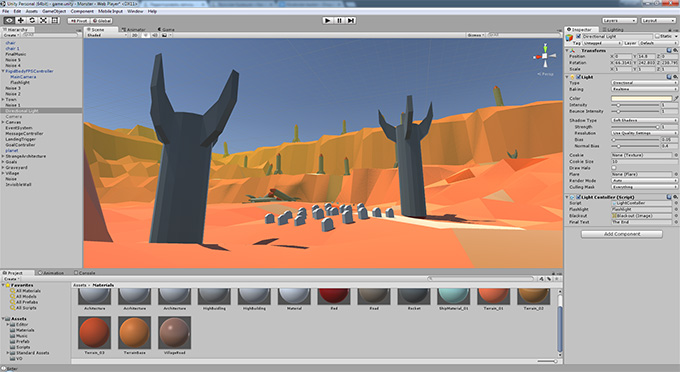
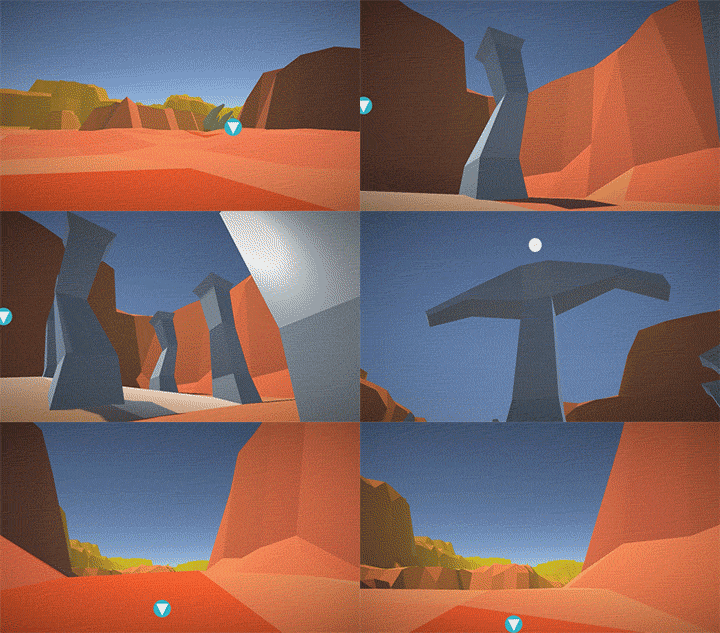
After thinking a little more, I concluded the concept was too complicated for a two-day marathon. So I removed extraterrestrial contact, combat and the confirmation button. Instead, the story would follow the player exploring an unknown planet—I really wanted to make a game about that—and gradually realizing humans had lived there and destroyed one another. The player isn't there to study the planet, but to see what their own species is capable of. To the robots communicating with them, humanity is a race of monsters. They brought the human, the player, there for a reason: a ritual of rubbing their nose in the mess before disposing of them. In fact, that plot didn't appear immediately. At first there were only a few disconnected ideas. I therefore tried a matrix approach. On one side was a list of entities that should be in the game: the world, the player, other characters. On the other was a list of requirements: how the game would hook players at the start, surprise them along the way and leave an impression at the end. It's like chasing a whole herd of rabbits, two at a time. If I introduce an entity, which game objective does it serve? If I want to meet an objective, which entity will I use? Thinking about the humor column, I decided to introduce a joker character: another voice besides those giving orders. Something like an onboard computer commenting on events. Later, however, this character changed from comic to tragic: a computer with its own opinion, therefore defective and marked for destruction along with its host. My biggest mistake was probably trying to put the player in something like a Mars rover, to add more physics when moving over uneven ground. I'd made a similar prototype before and thought it would be easy to repeat. The prototype itself was quick. I struggled a bit with the camera and ways to change the object's speed, but overall I produced a sort of brick capable of moving over an uneven low-poly mesh. The problem was that the brick handled terribly. It kept trying to overturn, fly into the sky or get stuck in a fold of the terrain. After spending most of day one on it, I threw it all away and used the standard first-person controller. Two other systems came together quickly, though. The first was a messaging system: a trigger could start a message, which could in turn start the next. Each message contained a name, text, portrait and voice recording. The second guided players towards their destination. I'd already considered such a system for another project, so I was happy to build it. A function made displaying an image at the right screen coordinates easy. The only problem was that a target behind the player still produced an image in front. I had to pin the image to the edge of the screen whenever the target wasn't in view. I planned the location using a cognitive map. I decided on five elements: 1) warming up and learning the controls; 2) the first signs of civilization; 3) stronger hints; 4) civilization at its height; 5) civilization's destruction; 6) escaping the trap; 7) the ending. All points follow sequentially and should form a winding route, with point 5 visible from the ending. As planned, on day one I only sketched the main topology, giving me something to test gameplay and timing on. The estimated playtime was 5–10 minutes, depending on how much players wandered. I also wrote all dialogue that day. Day two also went to plan: dressing the location, recording voices and music, and other beautification. Ordinary production without surprises. Except my imagination failed completely, so all objects ended up either obvious or abstract. There were playtests too, checking not only whether systems worked, but whether navigation was clear and the views were good. The settlements at point three, for example, weren't as interesting from the player's viewpoint as from a bird's-eye view in the editor. I had to route the player so they could see the settlements from above as well. All right, that's the boring part, so I'll skip it and go straight to the results. Surprisingly, quite a lot of people rated my game: 108 votes, although I had rated only about 40 games myself. For those unfamiliar with the system, getting your game shown in the showcase requires rating more games than the number of ratings you receive. So that many votes for my game remains an unexplained phenomenon to me. One of my biggest mistakes was the title. You enter it right at the end of the jam, when registering the project, by which time you have no energy left. Without much thought, I simply called the game Monster . That deprived me of any chance of finding mentions of it through Google. Don't repeat my mistake: choose a unique title, preferably at the concept stage rather than submission. There are lots of comments, most boiling down to simple points: atmospheric, beautiful, but confusing and boring to walk around. In other words, I repeated my mistakes from the previous Ludum Dare: too long a game and an overcomplicated interpretation of the theme. The only successful improvement was that most players reached the ending. Next time, I think I'll try to overcome my tendency to overcomplicate things and interpret the theme directly, as the games in the top 100 did. What makes them enjoyable isn't a unique take on the theme, but the quality of execution and attention to detail.