Nimatron
Nimatron entertained visitors in the Westinghouse pavilion at the 1940 New York World's Fair. Physicist Edward Condon proposed the machine, and engineers Gereld Tawney and Willard Derr helped build it. Electromechanical relays let it play Nim against a human opponent. Its display consisted of four groups of seven lamps rather than a television screen. A player extinguished one or more lamps in a single group; whoever removed the final light won. Starting positions allowed the human, who moved first, to win through correct play. A deliberate delay made the machine's response less intimidating. The patent was granted on September 24, 1940. This exhibition device illustrates an early connection between mathematical strategy, electrical machinery and public play.
The opening was not fixed: the patent describes nine successive starting combinations and column permutations. Here, Restart cycles through the nine combinations in the patent table. The buttons and top-down lamp sequence follow the documented principle.
Play ↓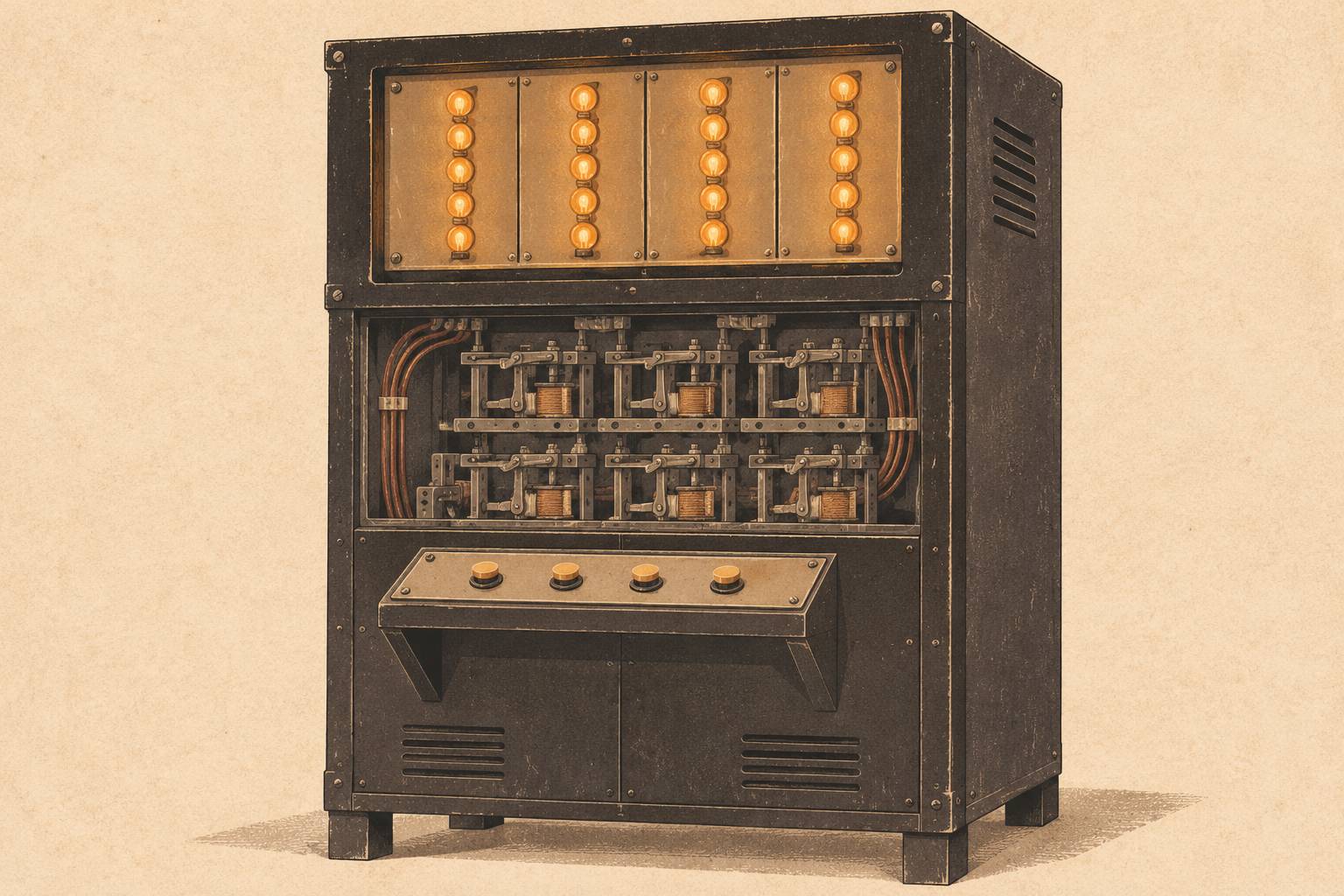
AI-assisted translation. Russian version
Play
A modern educational recreation of Nimatron. It preserves the rules of Nim with a newly implemented interface and algorithm.
The goal is to switch off the final lamp. Whoever does so wins.
Press Start.
Your goal is to switch off the final lamp. Press A, B, C or D: each press extinguishes one lamp from the top down. Use only one column per turn, then press Machine turn.
A contemporary AI-generated illustration.
How to play
- The goal is to switch off the final lamp. Whoever does so wins.
- Four vertical columns A–D each contain up to seven lit lamps.
- Press the button below one column: each press switches off one lamp. You may remove several, but cannot change columns during a turn.
- After at least one press, select Machine turn. You cannot skip a turn or relight lamps.