Tennis for Two
Visitors to Brookhaven National Laboratory first played Tennis for Two on October 18, 1958. Physicist William Higinbotham designed it for an open day, and technician Robert Dvorak built the apparatus from his circuits. An analog computer calculated the ball's movement while an oscilloscope displayed a side view of the court: ground, net and a luminous dot. Players did not move visible paddles. They set a shot angle with a dial and pressed a button while the ball was on their side. Gravity and bouncing gave the sparse display a physical character. There was no automatic scoring; players kept their own tally. A 1959 revision offered different gravity settings. The exhibit reveals how scientific instruments could become shared, responsive play spaces.
Play ↓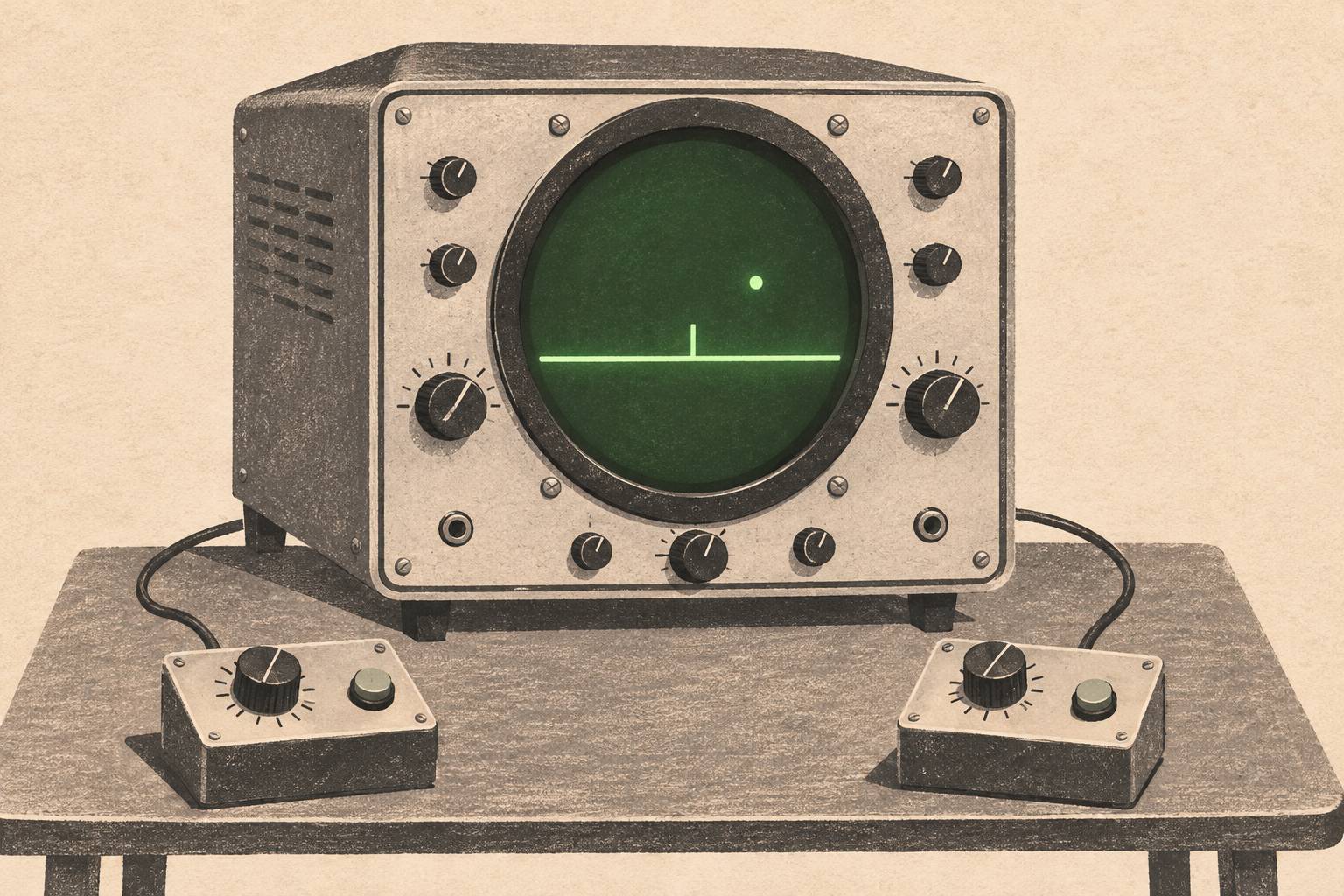
AI-assisted translation. Russian version
Play
A modern educational recreation of Tennis for Two. The side view and control principle are preserved; browser physics and rendering are newly implemented.
Press Start.
The computer opponent, touch controls and movement parameters are additions for this version.
Choose an angle and press Hit while the ball is on your side. A / L hit from the left / right. Press Serve after a failed rally.
A contemporary AI-generated illustration.
How to play
- Two players each have an angle control and a hit button.
- You can hit when the ball is on your side. Send it over the net, accounting for gravity and bounce.
- Reset to serve again after a failed rally. The historical apparatus did not keep score automatically.