Pong
Atari engineer Allan Alcorn created arcade Pong in 1972 after receiving an assignment from Nolan Bushnell. Two people turned control knobs to move vertical paddles and return a square ball. Missing gave the opponent a point; the simple rules made play immediately understandable. A prototype was tested at Andy Capp's Tavern in Sunnyvale. The Computer History Museum dates Atari's announcement to November 29, 1972. Pong helped make electronic games a prominent commercial attraction in bars and arcades. A separate home version followed in 1975. Screen-based table tennis had already appeared elsewhere, including the Magnavox Odyssey. Pong's importance therefore lies in its accessible design, popularity and commercial influence rather than an unconditional claim to have invented video games.
Play ↓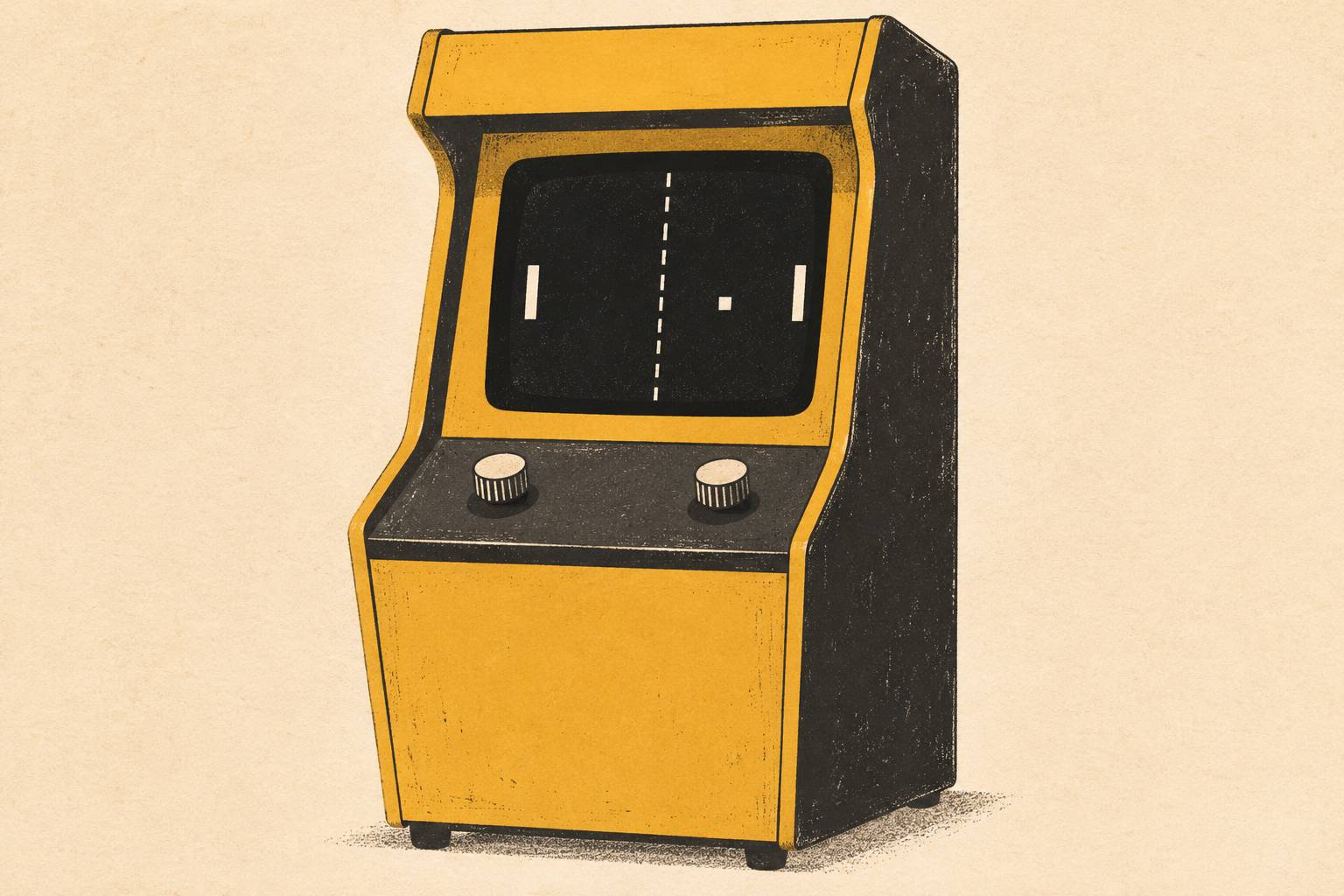
AI-assisted translation. Russian version
Play
A modern educational recreation of arcade Pong (1972). It is newly written for the browser; modern controls and additional modes differ from the original cabinet.
Press Start.
The computer opponent, touch controls and movement parameters are additions for this version.
Move the mouse or your finger to control the left paddle. Keyboard: W / S on the left, ↑ / ↓ on the right. First to 11 wins.
A contemporary AI-generated illustration.
How to play
- Two players move their paddles up and down to return the ball.
- The ball rebounds from the top and bottom boundaries. Letting it pass your paddle awards one point to the opponent.
- The original arcade hardware could be configured to end at 11 or 15 points.
Sources
- Pong (игра) — Википедия
- Computer History Museum — November 29: Atari Announces Pong Game
- Atari declares Pong Day on the game's 45th anniversary
- Computer History Museum — Pong
- National Museum of American History — Pong, Atari, and the origins of the home video game
- The Strong National Museum of Play — Pong
- Atari's 1972 Pong — FPGA reproduction documentation
- MobyGames — Pong (1972)